

If your readings feel inconsistent or harder to trust, weather anchor placement is usually the first thing to check.
The Delta system works by comparing pressure between units. When those units are experiencing similar conditions, noise gets canceled out and readings stay stable. When conditions don’t match, that difference shows up as movement in your elevation readings.
The card below shows what good and bad placement looks like. The top row is what you’re aiming for. The bottom row is what creates problems. The goal is to keep all Deltas in consistent conditions.
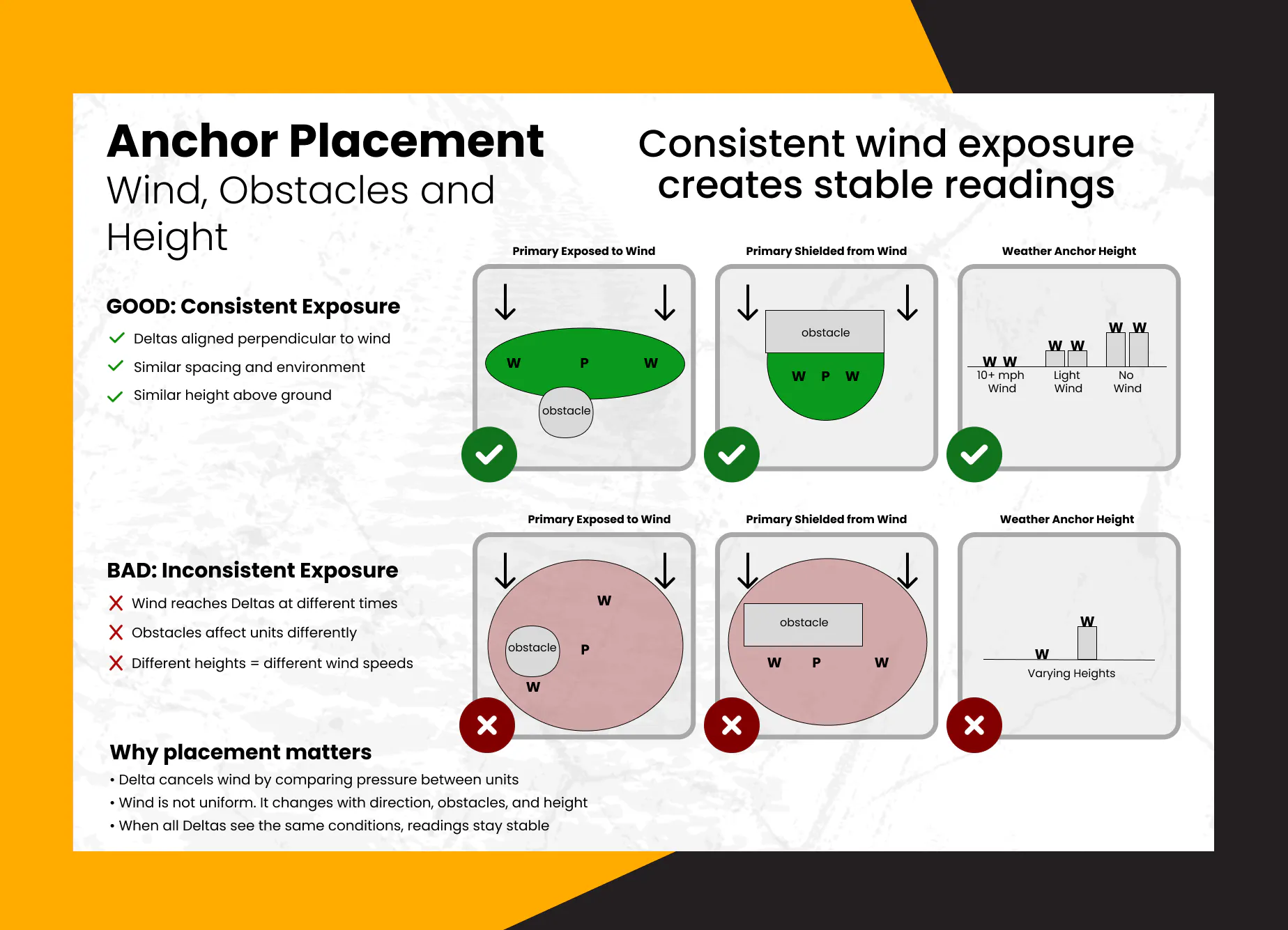
The card focuses on wind, obstacles, and height because those are the most visible and common sources of instability.
There is one more factor to keep in mind: temperature exposure (sun and shade).
Deltas can begin to thermally drift when they are heating or cooling at different rates. This can happen quickly. For example, if all units are in the shade and one moves into direct sun, you may start to see drift in under a minute.
Because of this, when you’re setting up, it’s important to treat sun and shade the same way you would wind or obstacles. Keep all Deltas in similar conditions.
One unit in sun while others are shaded
Anchors set at different heights to make placement easier
One unit exposed to wind while another is shielded
Obstacles affecting only part of the setup
Adaptive Filtration can smooth out short-term noise from wind and turbulence, but it won’t fix inconsistent placement.
If you’ve found a setup that works well in tough conditions, share it below. Real-world setups are some of the most helpful ways to help others dial in their systems.
-Rebecca
